
This post contains affiliate links. We may earn a small commission when you buy through our links — at no extra cost to you.
The gift aisle is full of boxes that promise glowing geodes, color-changing slime, and rockets that fly 100 feet. But many parents discover that the ‘glow’ never materializes, the rocket snaps on impact, and the geode is just a solid rock. That moment of letdown is all too common.
This guide weeded out the worst offenders and zeroed in on presents that consistently earn delighted squeals. From a STEM building kit that teaches electronics to a joke book that turns reluctant readers into comedians, each pick stands up to real-world play.
Whether you’re shopping for a quiet puzzle solver, a hands-on artist, or an energetic family game, the best gifts are the ones that function flawlessly from the first use. Every item in this list was chosen because it holds up to repeated play and actually does what it promises.


Best for Budding Engineers
Snap Circuits Jr. SC-100
Key Features
- Age & Complexity: Ages 8+, 100+ projects
- Educational vs. Entertainment: STEM electronics, hands-on
- Ease of Use: Picture manual, no tools
- Durability: Sturdy snap modules
- Power Source: None (no soldering)
- Price: Premium
The Snap Circuits Jr. SC-100 dispenses with wires and breadboards. Every component — from the motor to the speaker — snaps onto a sturdy plastic grid using fabric-fastener-like buttons. The full-color manual lays out each step as a visual map, so a child who hasn’t mastered reading can still build a working doorbell or a light-activated alarm. It’s a quiet antidote to toys that demand a screen or an app.
Behind the snap-and-play surface lies genuine electronics learning. Projects introduce resistors, capacitors, and transistors through cause and effect: change a resistor value and hear the pitch shift in a sound circuit, or flip a switch to see an LED respond. The progression from simple lamp circuits to a flying saucer that spins a fan keeps experimentation feeling fresh. Kids aren’t just assembling — they’re absorbing why a circuit works.
Durability is a standout trait. The plastic modules survive drops, enthusiastic pressing, and bin storage without cracking. Parents report the kit remaining functional through multiple children and months of on-and-off play. Engaged focus is the norm; a child can easily spend an afternoon building, taking apart, and inventing rudimentary circuits that go beyond the manual.
This kit fits a beginner inventor — typically ages 8–12, though a motivated 7-year-old can succeed with a little adult help at the beginning. Kids who already devour electronics books may race through the 100 projects and start eyeing expansion sets, but that trajectory is part of the design. For the target child encountering circuits for the first time, the scope hits the sweet spot between challenge and accessibility.
Pros
- Genuine electronics education hidden inside play — resistors, switches, and motors behave exactly as they would in a real circuit.
- Sturdy snap-together construction holds up to repeat assembly and accidental drops, lasting through years of use.
- Pictorial instruction style enables non-readers and visual learners to build independently.
- 100+ projects offer enough variety to sustain a child’s curiosity for weeks, not hours.
Cons
- Pictorial diagrams can be confusing for some kids at first; adult guidance often clears the hurdle within a session.
For a child’s first real electronics kit, Snap Circuits Jr. delivers durable, frustration-free learning that outlasts disposable toys and builds a sense of capability.
Best for Solo Puzzle Lovers
Gravity Maze Game
Key Features
- Age & Complexity: Ages 8+, 60 puzzles
- Educational vs. Entertainment: Spatial reasoning, logic
- Ease of Use: Single player, simple rules
- Durability: Durable plastic pieces
- Price: Mid-Range
Gravity Maze turns marble runs into logic puzzles, with 60 challenges that range from beginner to expert. Each card shows where to place the starting towers and the target, leaving the player to figure out the remaining placements using spatial reasoning. It’s a focused solo activity that contrasts with open-ended building kits by providing a clear goal and gradual difficulty progression.
This game clicks with kids ages 8+ who enjoy working through puzzles methodically and don’t mind a bit of trial and error. The game is best suited for quiet, stationary tabletop play; a bump-prone environment can disrupt the puzzle. It’s not a match for children who need immediate success or for group play seekers looking for multiplayer action.
Pros
- Engaging solo play that holds attention through building and testing marble runs.
- Sharpens critical thinking and sequential logic with each puzzle.
- 60 challenges across four difficulty levels keep the game fresh for years.
Cons
- Tower pieces may shift out of alignment if the board is nudged, interrupting the marble’s path.
It’s a focused, solo puzzle experience that grows with a child’s logic skills—ideal for quiet afternoons and kids who prefer independent challenges over group games.
Best for Crafty Kids
Dan&Darci Rock Painting Kit
Key Features
- Age & Complexity: Ages 6-12, simple painting
- Educational vs. Entertainment: Creative art project
- Ease of Use: Easy painting process
- Durability: 10 river rocks, paints
- Price: Mid-Range
The Dan&Darci kit includes 10 natural river rocks, puffy paints, glitter glue, and googly eyes — everything needed for an afternoon of painting without a screen. The process is simple: paint, stick on accessories, and let dry. It’s a lower-tech alternative to the top pick’s circuit-building, ideal for kids who prefer decorating over assembling.
Best suited for crafty kids ages 6–10, this kit shines on rainy days or as a grandparent-grandchild activity. The glow-in-the-dark paint may not produce visible results even after charging, so treat that feature as a bonus rather than the main draw. The rocks are also smaller than some may expect, which can make detailed painting trickier, but younger children typically don’t mind the size.
Pros
- Keeps kids engaged for hours with creative painting and decorating.
- Makes a thoughtful gift for crafty kids and family activity time.
- Appropriate for a range of ages from 6 to 12.
Cons
- Glow-in-the-dark paint may not light up even after exposure to light.
- Rocks may be smaller than expected, making detailed painting more challenging.
A worthwhile craft buy if you’re after a screen-free painting activity — but don’t expect the glow effect to deliver.
Best for Curious Readers
Nat Geo Kids Why? Book
Key Features
- Age & Complexity: Ages 7-12, 1,111 answers
- Educational vs. Entertainment: Trivia learning, fun facts
- Ease of Use: Illustrated, easy to read
- Durability: Hardcover, 224 pages
- Price: Mid-Range
Where the joke book in this set encourages laughter and reading aloud, this hardcover feeds curiosity on a different wavelength — every page poses a question, serves a crisp answer, and surrounds it with stunning wildlife and science photography. The bite-sized text and clear layout make it a natural pick for kids who shy away from long-form reading but will happily absorb facts for hours.
It’s the ideal companion for family road trips, restaurant waits, or any moment when a child asks ‘why?’ and a quick, satisfying answer is needed. Kids aged 7–12 who crave random trivia will treat it like a treasure map; those expecting deep dives on a single subject or fictional stories may find the broad, browsing-centric format less engaging. The hardcover format is sturdy and substantial, doubling as a coffee-table book that adults will thumb through as often as kids.
Pros
- Packed with 1,111 engaging facts that spark curiosity in kids and adults alike.
- Vivid National Geographic photos and illustrations that make every page visually exciting.
- Short, digestible paragraphs let reluctant readers flip open anywhere and learn independently.
Cons
- Answers are brief and don’t explore topics deeply, which may frustrate a child wanting thorough understanding of a subject.
- The random-access, non-narrative structure may not hold the attention of those who prefer stories or sequential learning.
This book belongs in the hands of any kid who peppers adults with ‘why’ — it’s the kind of gift that gets picked up again and again, long after the wrapping paper is gone.
Best for Family Game Night
The Floor is Lava! Game
Key Features
- Age & Complexity: Ages 5+, simple rules
- Educational vs. Entertainment: Physical play, no electronics
- Ease of Use: Quick setup, carpet recommended
- Durability: Foam tiles, air out first
- Price: Mid-Range
Unlike passive screen entertainment, The Floor is Lava! turns any carpeted room into an obstacle course of 25 foam stepping stones, with a spinner and challenge cards keeping play unpredictable. The rules are easy for a 5-year-old to follow and setup takes less than a minute.
It’s a reliable energy burner for families with kids 4–8, especially when weather keeps everyone indoors. The tiles grip well on carpet but can slip on hardwood or tile—factor in a non-slip mat or rug if that’s your play space. New sets also carry a strong plastic smell that fades after a day or two of airing out.
Pros
- Gets kids jumping, stretching, and laughing within seconds of opening the box
- Brings together mixed ages for a genuinely fun family game night
- Simple rules and under-a-minute setup mean play starts fast
Cons
- Foam tiles can slide on hardwood or tile floors
- Strong chemical odor when first opened—needs airing out before play
A hands-on gift that gets the whole family giggling and moving, just be ready to clear a carpeted area and let the tiles breathe before game night.
Best for Budding Artists
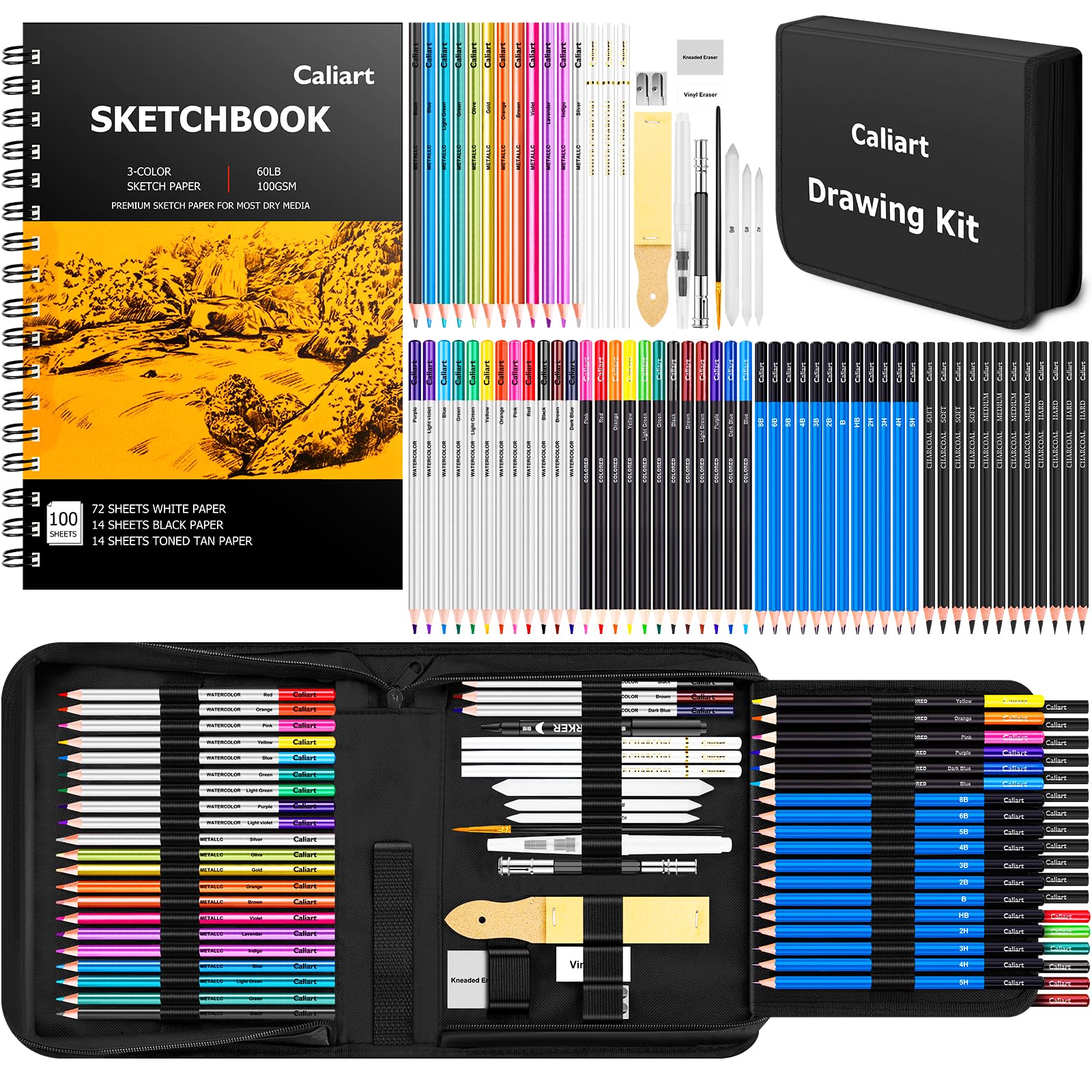
Caliart 176PCS Art Set
Key Features
- Age & Complexity: Ages 10+, multi-medium
- Educational vs. Entertainment: Art skills, drawing
- Ease of Use: All-inclusive kit, portable case
- Durability: Quality pencils, case included
- Price: Premium
This art kit brings together graphite, colored, watercolor, charcoal, and metallic pencils in one portable case – a broader range than many separate purchases offer. The pencil quality supports smooth shading and vibrant color, while the 100-sheet sketchbook with white, tan, and black paper lets beginners explore tone and contrast.
Best for artists ages 10 and up who are curious about multiple mediums but not yet ready for professional-grade supplies. The included sharpener may feel flimsy during heavy use; a standalone sharpener is a practical upgrade.
Pros
- Pencil quality supports smooth shading and vibrant color laydown
- More than 70 tools cover drawing, sketching, and coloring in one purchase
- Includes a sketchbook with white, tan, and black paper to build technique across surfaces
Cons
- Included sharpener may feel flimsy during heavy use
For a young artist wanting to experiment with drawing and coloring across multiple mediums, this kit provides a solid start without requiring separate purchases.
Best for Magic-Loving Kids
Nat Geo Magic Chemistry

Key Features
- Age & Complexity: Ages 8+, 10 magic tricks
- Educational vs. Entertainment: Science magic tricks
- Ease of Use: Adult supervision, simple
- Durability: 10 experiments, props included
- Price: Mid-Range
The 10 tricks—from vanishing water to levitating a coin—use real chemical reactions and feel like a stage act, complete with a wand and white gloves. Instructions are clear and kid-friendly, making setup straightforward for young magicians. The set is limited to 10 experiments, so the novelty may fade faster than a larger kit. A few kits arrive missing small components, but checking the box on arrival catches any omissions early.
Pros
- Fun, engaging experiments that feel like real magic
- Easy-to-follow, kid-friendly instructions make setup quick
Cons
- Limited to 10 experiments
- Some kits arrive missing small components; checking contents on arrival remedies this
For a magic-themed gift that introduces a handful of chemistry concepts, this kit fits when you open it early to confirm all pieces are present and don’t expect a sprawling lab.
Best for Mermaid Fans
Mermaid Terrarium Kit

Key Features
- Age & Complexity: Ages 5-8, tiny garden
- Educational vs. Entertainment: Plant growing craft
- Ease of Use: Simple, quick seeds
- Durability: Plastic jar, small parts
- Price: Budget
This mini garden kit delivers an instant hit of creativity for young mermaid enthusiasts. Chia seeds sprout within days, and decorating the terrarium with stickers, colored sand, and pearls keeps small hands busy. The narrow appeal keeps it out of the top spots: it’s a hit with mermaid-obsessed 5-8 year olds but falls flat for older kids or anyone wanting a larger project. The finished piece is a charming, affordable stocking stuffer that fits a very specific niche.
Pros
- Adorable mermaid theme with stickers, pearls, and mini figures that kids love personalizing.
- Chia seeds sprout in 3-5 days, giving young gardeners a fast reward.
Cons
- The terrarium is very small at 5.25” h x 3” w — more of a keepsake trinket than a garden display.
A sweet niche gift for a mermaid-obsessed 5-8 year old who enjoys quick results — not the choice for older kids or anyone seeking a large-scale craft.
Best for Budding Comedians
The Big Book of Silly Jokes

Key Features
- Age & Complexity: Ages 5-12, easy jokes
- Educational vs. Entertainment: Reading practice, humor
- Ease of Use: Simple text, no pictures
- Durability: Paperback, 160 pages
- Price: Budget
Packed with 160 pages of clean, shareable humor, this collection gives emerging readers a reason to practice reading aloud. Short knock-knocks, riddles, and puns suit 5- to 8-year-olds who decode basic sentences. The sparse pictures can leave pre-readers needing a helper. For kids ready to tell jokes independently, it’s an inexpensive fluency booster.
Pros
- Clean, silly jokes that kids enjoy telling to friends and family
- Boosts reading confidence in early readers with short, manageable text
Cons
- Sparse illustrations can lose pre-readers who still heavily rely on pictures
- Certain wordplay or punchlines may miss kids under 6, needing a parent to explain
For early readers who can handle short paragraphs and want to delight family with clean jokes, this budget-friendly book offers a low-stakes way to build fluency.
Best for Travel Artists
ZMLM Scratch Art Notebooks

Key Features
- Age & Complexity: Ages 3-8, scratch art
- Educational vs. Entertainment: Creative, no mess
- Ease of Use: Simple stylus, scratch
- Durability: Pages non-reusable
- Price: Budget
The notebooks offer instant, screen-free creativity — children scratch away the black layer to reveal vivid rainbow patterns. The compact size and no-paint design make them ideal for car rides and restaurant waits. Because each page is single-use, the set won’t last indefinitely, but two notebooks plus four styluses provide plenty of entertainment for a trip or a rainy afternoon.
Pros
- Keeps young artists busy for hours with a satisfying scratch-to-color reveal.
- Compact and lightweight — easy to pack for travel, restaurants, and waiting rooms.
Cons
- Scratching releases tiny black flakes that can scatter onto tables or laps.
A solid pick for road-trip kits and quiet bins for kids 3–8, provided the small flake cleanup doesn’t outweigh the benefit of a paint-free creative outlet.
Best for Space Lovers
Astronaut Star Projector

Key Features
- Age & Complexity: Ages 5+, room decor
- Educational vs. Entertainment: Atmosphere light, calm
- Ease of Use: Remote control, timer
- Durability: Plastic housing, magnetic head
- Power Source: USB (adapter not included)
- Price: Premium
With eight colorful nebula modes and a field of green laser stars, this astronaut-shaped projector delivers an enchanting light show that fascinates children as they drift off. The magic has a caveat: durability varies, and the device can stop working after months, not years. It’s a showpiece for a child who will be wowed by the initial spectacle rather than a reliable nightly nightlight for the long haul.
Pros
- Mesmerizing starry projection with 8 nebula effects and green stars.
- Creates a calming, magical atmosphere that soothes kids at bedtime.
Cons
- Remote control may become unresponsive over time.
A stellar gift for families who value an atmospheric bedtime light show and are willing to accept a shorter-than-expected operational life.
Best for Light-Haired Kids
Desire Deluxe Hair Chalk

Key Features
- Age & Complexity: Ages 3+, temporary color
- Educational vs. Entertainment: Dress-up fun
- Ease of Use: Just chalk on hair
- Durability: 10 pens, washable
- Price: Mid-Range
Ten chalk pens in glitter and standard shades deliver temporary hair color for dress-up and parties, washing out easily with shampoo from both hair and skin. The color payoff is limited on dark hair, and the chalk can transfer to clothes and pillowcases if not handled carefully. This makes it a better fit for light-haired children who love costume play and don’t mind a bit of cleanup.
Pros
- Fun, temporary color that brightens dress-up and party looks.
- Washes out easily with shampoo from hair and skin.
Cons
- Color may barely show on dark or brunette hair.
- Can transfer to clothing and pillowcases during use.
A fitting gift for blonde or light-haired kids who enjoy costume play and temporary hair color; families with dark-haired children or a low tolerance for mess should look elsewhere.
How to Choose
The biggest mistake is grabbing the toy with the boldest claims on the box without checking whether it works as advertised when the child rips it open.
Age & Complexity
The age range on a box isn’t just a safety suggestion—a 7-year-old with developing fine motor skills may fumble with tiny snap connectors, while a 10-year-old can find a simple puzzle babyish. A gift that asks for just beyond their current ability keeps them hooked without flaring frustration.
A hidden trade-off: projects labeled “8+” often require adult help for the first few sessions, especially in kits with picture-based instructions. That’s fine for bonding time, but if you need a gift they can tackle independently on a long car ride, look for truly self-guided sets.
Educational vs. Entertainment
Many gifts proudly wear an “educational” label, but the learning often stops at a vocabulary word on the box. The best picks weave skill-building into the fun so seamlessly that kids don’t realize they’re practicing spatial reasoning or reading fluency.
A logic puzzle game teaches problem-solving through trial and error, while a joke book builds confidence in early readers because they’re motivated to share a punchline. If a child dreads textbooks, lean toward options where the activity itself—not a lesson plan—holds their attention.
Ease of Use
The simpler the setup, the more likely the toy actually gets played with. Kits that demand a parent decipher a 20-page manual or that require constant “Mom, fix this!” lose their charm before lunch.
Look for offerings with picture-based instructions, snap-together pieces, or one-button operation. The hidden friction isn’t just wasted time; it’s that a child’s enthusiasm evaporates when independence is blocked, turning a present into a chore.
Durability & Materials
A plastic stand that cracks on the first stomp or a puzzle piece that bends out of shape ends up in the bin. The materials matter as much as the concept: thick cardboard pages survive repeated flipping, dense foam tiles resist tearing under kid feet, and snap modules hold their connection through dozens of builds.
Cheaper kits often skimp on construction, resulting in toys that fail within weeks. If a box feels flimsy in your hand, it likely won’t survive a 6-year-old’s enthusiasm.
Power & Supply Needs
Electronics introduce a hidden dependency: batteries, USB cords, or an absent wall adapter. A star projector that requires a USB power bank tethers the fun to your accessory drawer. Meanwhile, a classic marble maze or art set needs nothing but a flat surface.
Before buying, check what’s included versus what you must supply separately. A gift that demands an additional purchase or a constant power outlet can stall excitement the moment the batteries die mid-play.
FAQ
Can I take a rock painting kit on a plane for a trip?
The rocks and brushes can ride in your carry-on, but any liquid paints over the TSA limit must go in checked luggage. The kit’s small size makes it a handy hotel craft, though the tiny rocks can get lost on the floor—bring a tray or tablecloth to contain the mess.
Will the Floor is Lava game foam tiles work safely on a hotel room carpet?
Yes, the foam tiles are designed for carpeted surfaces and stay put during active jumping. Just check that the hotel carpet is clean and free of sharp debris that could tear the foam, and air out the tiles beforehand since they can have a temporary factory smell.
How long does the hair chalk last before washing out, and will it rub off on pillowcases?
The color typically washes out with a single shampoo, but while dry it can transfer to pillowcases and light clothing. If you’re on the road, use an old pillowcase or have the child wash their hair before bed to keep hotel linens clean.
Does the astronaut star projector need to stay plugged in, or can it run on batteries for travel?
It’s USB-powered and doesn’t include a battery, so you’ll need a portable power bank or a nearby USB outlet. That makes it less ideal for a camping trip without power, but a small power bank in a hotel room works fine for a few hours of galaxy projection.