
This post contains affiliate links. We may earn a small commission when you buy through our links — at no extra cost to you.
A first birthday gift should be the start of a love affair with play—not a source of frustration. Yet too many toys marketed for 12-month-olds are either too complex for their developing motor skills or so small they’re outgrown within weeks. Parents end up with a pile of plastic that gathers dust while their toddler wonders what all the fuss was about.
The best gifts for a one-year-old hit a narrow target: they support emerging walking, grasping, and babbling skills while standing up to drops, drool, and the occasional tantrum. In this guide, every pick has been chosen because it actually fits a child’s real developmental stage—not just the label on the box. That means you’ll find sturdy balance bikes sized for short legs, board books with buttons a 12-month-old can press, and musical toys that survive being thrown across the room. The only question is whether you prioritize a big movement milestone or independent quiet play—a choice we make clear upfront.



Best for New Walkers
SEREED Baby Balance Bike
Key Features
- Age Fit: 12-24 months
- Educational Focus: Balance, gross motor
- Build Quality: Aluminum frame, 3.5 lbs
- Assembly & Portability: Tool-free, 1-2 min
- Price: Mid-Range
SEREED’s baby balance bike uses a 135° steering limit and four non-scratch TPU wheels to keep early riders upright during clumsy turns. The silent wheels roll across hardwood and tile without leaving marks, and the aluminum frame weighs just 3.5 pounds — easy for a parent to carry to the park or stash in a diaper bag. Assembly takes under a minute with no tools needed, so the bike is ready to ride out of the box.
This bike is built for the smaller toddler — the fixed seat works best for children around 12 to 18 months who are on the shorter side. Taller toddlers or those approaching 24 months may find the seat too low, forcing a hunched position and limiting the bike’s useful life to about six months. For parents prioritizing a safe, confidence-building first ride-on that fits a specific growth window, this delivers exactly that.
Pros
- Assembles in under a minute with no tools required
- Four wheels and a 135° steering limit make it very stable for new walkers
- Minimalist cruiser design that attracts toddlers and fits modern home decor
Cons
- Fixed low seat height means taller or older toddlers (18+ months) may outgrow it quickly
The SEREED bike gives 12-month-olds a confident start to balance and scooting, but the fixed seat limits its useful life to the smaller side of the toddler growth curve — buy it for the early months, not for longevity.
Best for Language Learning
LeapFrog 100 Words Book
Key Features
- Age Fit: 18+ months
- Educational Focus: Bilingual, vocabulary
- Build Quality: Durable hard pages
- Assembly & Portability: Ready to use, portable
- Price: Budget
The LeapFrog Learning Friends 100 Words Book shifts the focus from gross-motor first-birthday gifts to early vocabulary acquisition. Its durable plastic pages survive rough handling, and the bilingual format introduces words in both English and Spanish through cheerful voice prompts. This fits families wanting an educational foundation rather than immediate physical activity. However, volume can be inconsistent and some units may stop responding over time, so it suits buyers who can accept occasional sound quirks.
Pros
- Teaches 100+ words in both English and Spanish with playful sounds
- Durable plastic pages hold up to rough toddler handling
- Commonly praised as a go-to first birthday gift for language development
Cons
- Volume may be lower than expected and can cut out intermittently on some units
A budget-friendly way to introduce a second language early, but plan to test the specific unit’s sound if volume consistency matters.
Best for Pretend Play
LeapFrog Picnic Basket
Key Features
- Age Fit: 6 months+
- Educational Focus: Shapes, colors, manners
- Build Quality: 15 pieces, carry basket
- Assembly & Portability: Portable, all-in-one
- Price: Mid-Range
Where the bilingual touch book drills vocabulary, this picnic set turns learning into a social game. Six shape-sorting food pieces slide into the basket while the toy responds with colors, shapes, and polite phrases like ‘please’ and ‘thank you.’ Music and sound effects reward correct sorting. It’s best for toddlers who love pretend tea parties and parent-assisted play — the basket’s short handle and pink-only design mean it’s not for independent carriers or those wanting a gender-neutral gift.
Pros
- Teaches shapes, colors, and manners through playful songs and polite phrases.
- Keeps toddlers engaged with shape sorting and interactive responses that hold attention.
- Makes an excellent first-birthday gift, with all 15 pieces fitting neatly inside the basket.
Cons
- Handle is short and stiff, making it hard for a child to open or carry the basket independently.
If you want a toy that makes shape sorting a social event and don’t mind lending a hand with the handle, this basket offers charm and learning that fits a first birthday girl beautifully.
Best for Active Learners
VTech Chomp & Count Dino
Key Features
- Age Fit: 12 months-3y
- Educational Focus: Numbers, colors, food
- Build Quality: Sturdy plastic, withstands drops
- Assembly & Portability: Pull-toy, ready
- Price: Mid-Range
Unlike static floor toys, VTech’s Chomp and Count Dino turns learning into active play: toddlers pull it by a string, then feed it colored food pieces that trigger counting and song responses. The 130+ songs and melodies provide varied audio feedback, and the durable plastic body holds up to the drops common at this age.
This toy suits dinosaur-loving toddlers who enjoy putting objects into containers, but the feeding chute requires precise alignment — some younger 1-year-olds may need an adult to help push pieces fully into the mouth. Many families report it’s a hit as a first birthday gift, especially for kids already drawn to cause-and-effect toys. It’s best where a caregiver can assist during play and where a quiet toy isn’t the goal.
Pros
- Feeding Dino colored food pieces makes counting and color recognition fun and hands-on.
- Sturdy build stands up to drops and rough toddler play.
- Frequently chosen as a first birthday gift, often a big hit with toddlers.
Cons
- Feeding the food pieces into Dino’s mouth requires precise alignment; younger toddlers may need adult help to avoid frustration.
A durable, interactive pull-toy that rewards persistence — best for toddlers who already enjoy container play and have a caregiver to assist with the feeding mechanism.
Best for Keepsake Book
Happy Birthday to You!
Key Features
- Age Fit: 1+ years
- Educational Focus: Literacy, birthday theme
- Build Quality: Hardcover, 64 pages
- Assembly & Portability: Standard book, portable
- Price: Budget
Happy Birthday to You! transforms a simple read-aloud into a family heirloom when used as a birthday guest book, with party guests signing its pages.
The lyrical Seussian rhymes and vibrant art captivate even the youngest listeners, and families often revisit it on each birthday. Paper pages can tear if grabbed by curious hands—this isn’t a board book for unsupervised chewing. For parents who want a signed memento for a first birthday, that tradeoff is easily managed during supervised read-aloud time.
Pros
- Doubles as a birthday guest book for party signatures, creating a lasting keepsake.
- Lyrical, joyful rhymes become a bedtime favorite, with children asking to read it nightly.
- Timeless Dr. Seuss art and celebration theme suit children from age 1 and up.
Cons
A sentimental first-birthday gift that grows into a cherished tradition—just keep it on a high shelf between read-alouds.
Best for First Library
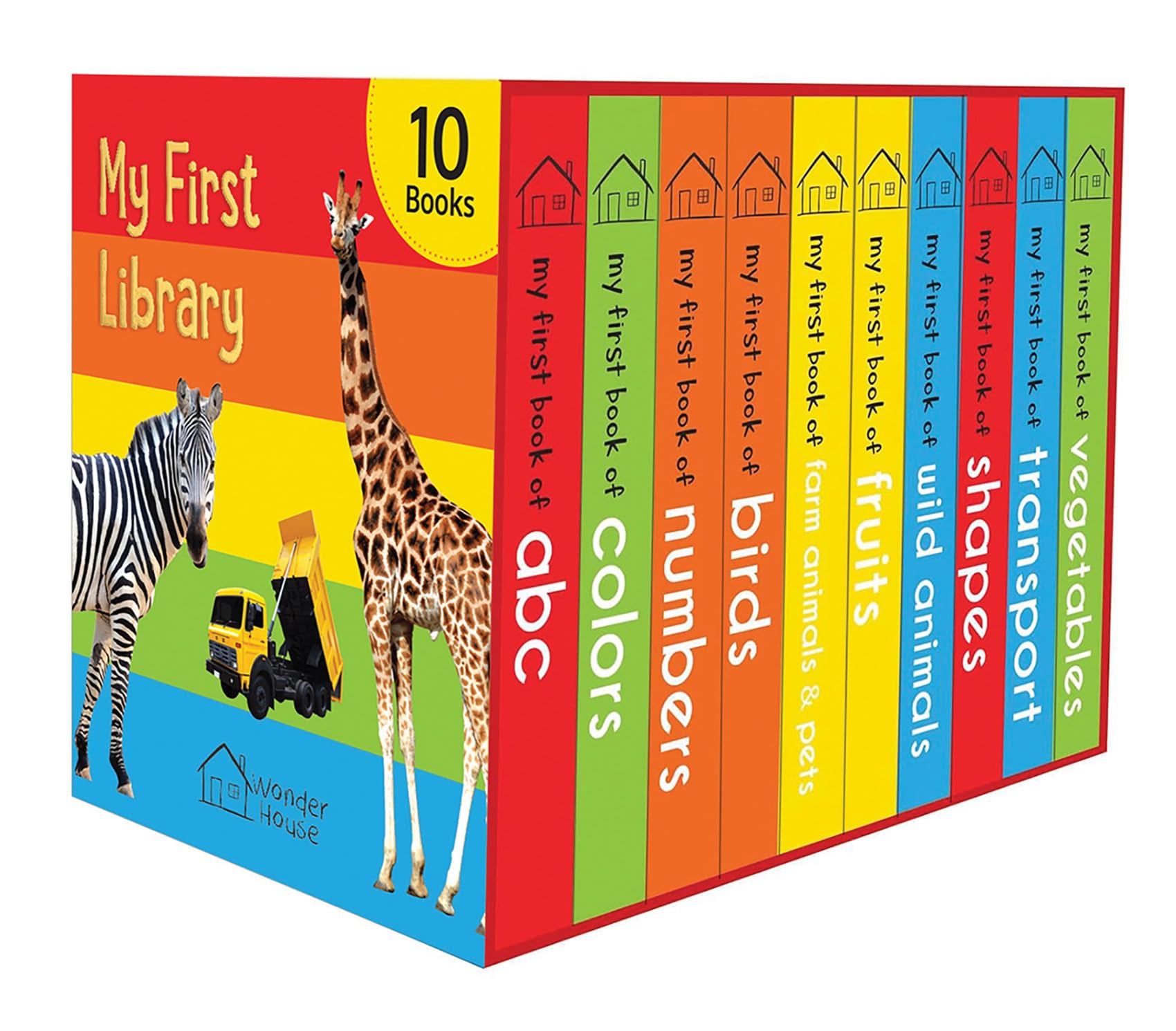
My First Library 10 Books
Key Features
- Age Fit: 1-2 years
- Educational Focus: ABCs, numbers, colors
- Build Quality: Board books, slipcase
- Assembly & Portability: Compact, 10 tiny books
- Price: Mid-Range
This set packs ten topic-specific board books into a travel-friendly box, covering ABCs, numbers, colors, animals, and more — each book sized for small hands to carry and turn.
Best for budget-conscious parents building a first home library or grandparents seeking a gift that will see years of use. However, occasional factual errors or misprints have been noted, so a quick content review before gifting is wise.
Pros
- Compact board books sized for small hands; toddlers can easily carry and turn pages.
- Covers all basic early learning topics — ABCs, numbers, colors, animals — in one box.
Cons
- Some copies contain mislabels or factual errors; a quick scan before gifting avoids confusion.
A popular, affordable first book set that covers the basics, but occasional quality control slip-ups mean parents should check content before handing to a toddler.
Best for Travel Toy
iLearn Press & Go Cars
Key Features
- Age Fit: 6 months+
- Educational Focus: Fine motor, cause-effect
- Build Quality: ABS plastic, spring mechanism
- Assembly & Portability: Pocket-sized, no battery
- Price: Budget
Unlike the top-pick balance bike, which encourages first steps, this set of four animal cars focuses on portable, no-battery quiet play. Each car zooms forward with a press on the animal’s head—silent, friction-powered, and small enough to slip into a purse. For parents navigating long car rides, restaurant waits, or any situation where a silent toy is gold, these are a low-cost lifesaver. A few cars may lose their spring mechanism over time and stop self-propelling, but for short bursts of distraction, toddlers still enjoy pushing them manually.
Pros
- No batteries needed — press the animal head and the car races forward silently.
- Compact size fits in a purse or diaper bag, making it ideal for travel and on-the-go.
- Cute animal characters and quiet operation work for both boys and girls without adding noise.
Cons
- Some cars may lose their spring action after moderate use and stop self-propelling.
For quiet play during car rides, meals out, or visits to grandma’s, these cars are a clever budget choice—and even if the spring fades, toddlers still enjoy pushing them manually.
Best for Infant Floor Play
VTech Pull & Sing Puppy

Key Features
- Age Fit: 6-36 months
- Educational Focus: Numbers, colors, body parts
- Build Quality: Durable, survives drops
- Assembly & Portability: Pull string, stationary
- Price: Budget
The VTech Pull and Sing Puppy engages sitting babies with three buttons that teach numbers, colors, and body parts, and a light-up nose. It’s durable. The pull string is only about 20 inches, forcing a standing toddler to hunch — pull-along play doesn’t work. For pre-walkers, that’s irrelevant, and the low price makes it a cheerful gift.
Pros
- Extremely cute and engaging for floor play, with catchy songs and a light-up nose that hold infant attention.
- Surprisingly durable construction that withstands drops and throws without damage.
- Budget-friendly price makes it a low-risk, high-smile gift for the youngest recipients.
Cons
- Pull string is only about 20 inches long, forcing a standing toddler to hunch over, making pull-along use impractical.
A delightful floor toy for sitting babies, but once walking starts, its short string turns it into a stationary buddy. Best suited for the 6–10 month stage.
Best for Light-Up Ride
Gamfeiny Balance Bike

Key Features
- Age Fit: 10-36 months
- Educational Focus: Balance, gross motor
- Build Quality: Carbon steel, LED wheels
- Assembly & Portability: Tool-free snap
- Price: Mid-Range
The light-up wheels are the main draw, glowing without batteries as kids roll. Tool-free snap assembly takes minutes, and the sturdy steel build holds up for early riders. However, the bike can tip when a child turns sharply or leans, making it less stable than the SEREED for confident cornering.
Pros
- Glowing wheels captivate toddlers and make riding exciting.
- Snap-together design means no tools and a quick start.
Cons
Fits best in well-lit indoor spaces where the glowing wheels entertain during gentle rolling, and tight turns aren’t on the menu.
Best for Tiger Lovers
YGJT Tiger Balance Bike

Key Features
- Age Fit: 10-36 months
- Educational Focus: Balance, movement
- Build Quality: Carbon steel, 5.2 lbs
- Assembly & Portability: Tool-free, 1-2 min
- Price: Premium
The tiger’s animated mouth and sturdy steel frame make this a fun, durable indoor ride. The narrow wheelbase can lead to tipping during turns, so it’s best for gentle straight-line cruising on smooth floors. At this price, the top pick offers more stable steering for daily use.
Pros
- Charming tiger design with an animated ‘chewing’ mouth that delights young riders
- Sturdy carbon steel frame holds up to rough indoor use
Cons
- Narrow wheelbase can cause tipping during sharp turns
A charming choice for tiger-loving toddlers who will ride gently on smooth floors; the top pick provides better stability for more active riders.
Best for Retro Style
Retrospec Cricket Balance Bike

Key Features
- Age Fit: 12-24 months
- Educational Focus: Balance
- Build Quality: Plastic, 4 lbs
- Assembly & Portability: 95% assembled
- Price: Premium
The Retrospec Cricket delights with its vintage styling and non-scratch wheels, making it a charming indoor ride for a photo-ready first birthday. The very low step-in height encourages cautious new walkers. However, plastic hub caps can pop off during use, so it’s best suited for light indoor cruising rather than daily outdoor riding.
Pros
- Retro aesthetic stands out and photographs beautifully for first birthday moments.
- Very stable base prevents tipping, giving timid new walkers confidence.
Cons
- Plastic hub caps can detach during rides, requiring occasional reattachment.
Best for families who want an eye-catching prop for first-birthday photos and gentle indoor scooting — not for toddlers eager to ride daily.
Best for Supervised Sorting
Aigybobo Farm Animals Set

Key Features
- Age Fit: 12-36 months
- Educational Focus: Counting, sorting, animals
- Build Quality: Vinyl animals, plastic barns
- Assembly & Portability: No assembly, small pieces
- Price: Budget
Ten brightly colored barns with numbered lids reveal soft vinyl animal finger puppets that teach counting, colors, and animal names. Children enjoy opening the barns and matching animals. However, the hard plastic barns can have sharp edges that risk scratches—supervise closely or sand them down. Not suitable for unsupervised independent play.
Pros
- Teaches numbers, colors, animal names, and fine motor skills through hands-on sorting and matching.
- Cute, colorful animal finger puppets and barns engage toddlers and make learning playful.
Cons
- Plastic barn edges may be sharp and can scratch or cut little fingers during handling.
Best for parents who want a hands-on counting and sorting activity and can supervise closely or smooth rough edges before play.
Best for Read-Aloud Fun
Eric Carle Animal Sounds Book

Key Features
- Age Fit: 1-2 years
- Educational Focus: Animal sounds, words
- Build Quality: Hardcover, 30 buttons
- Assembly & Portability: Standard book, portable
- Price: Budget
For a 1-year-old’s birthday, this sound book enchants Carle fans with 30 animal noises and beautiful illustrations. The stiff buttons may require more force than a toddler’s fingers can apply, so it’s not a solo activity — unlike the touch-sensitive pages in the other word book here, which responds to light taps. This is best for shared reading where an adult handles the presses.
Pros
- Vibrant Eric Carle artwork and realistic animal sounds captivate toddlers during read-alouds.
- Works well for car rides and restaurant entertainment when an adult presses the buttons.
Cons
- Buttons require firm pressure, and toddlers may need adult help to activate the sounds.
If you’re after a beautiful sound book for shared lap-reading and don’t mind doing the button pressing yourself, this is a charming pick; for hands-off solo play, look elsewhere.
How to Choose
The most important thing to know is that a toy’s age label can be misleading—focus on what your child can actually do right now, not what the box says.
Age and Developmental Fit
A 12-month-old is at a transition point: some are crawling, others are walking, and fine motor skills vary wildly. Toys labeled ‘6+ months’ can feel too babyish, while many ’18+ month’ items require coordination a new one-year-old hasn’t mastered yet. The hidden trade-off is that a perfectly matched gift today may only last 3 to 6 months before your child outgrows it, so prioritize toys that stretch just slightly ahead of their current ability.
Check whether the toy demands skills like squeezing, pressing, or balancing that your child is actively practicing. A balance bike sized for 12–18 months builds gross motor confidence immediately; a vocabulary book designed for 18+ months will sit unused for weeks if your toddler can’t yet isolate a fingertip on a tiny sensor.
Educational Focus
Toys for one-year-olds zero in on a few core areas: vocabulary and first words, colors and shapes, gross motor (walking, pushing, riding), or fine motor (grasping, feeding, sorting). No single toy does it all. A push for early language often means a quieter, stationary activity, while a ride-on prioritizes movement over vocabulary.
Decide which skill you want to support, and accept that the toy will be best in that lane. A bilingual book builds language beautifully but won’t help your child practice walking; a shape-sorting picnic set teaches colors and manners through pretend play but won’t introduce numbers in two languages.
Build Quality and Durability
One-year-olds chew, drool, drop, and throw. Materials matter: hard plastic pages survive moisture; carbon steel and aluminum frames handle rough riding better than plastic frames that can crack. Pay attention to failure points—spring-loaded mechanisms in press-and-go cars or pop-up toys can wear out after a few weeks of enthusiastic use, while simple mechanical designs without batteries often last longer.
For ride-on toys, a heavier metal frame adds stability but makes the toy harder for a child to carry. The trade-off is that plastic frames are lighter and cheaper, but hub caps and axle covers can snap off, especially when used daily on hard floors.
Assembly and Portability
A gift that requires 20 minutes of screwing and hunting for a missing Allen key kills the birthday excitement. Look for tool-free, snap-together designs whenever possible. Portability becomes essential if you travel or visit grandparents: a balance bike that weighs under 4 lbs is easy to toss in the trunk, and a set of tiny cars or board books fits in a diaper bag without a second thought.
The hidden factor is that highly portable toys often sacrifice other features—a pocket-sized car set has no electronics, a snap-together bike may feel less solid than a bolted frame. For families on the go, the trade-off is often worth it.
Safety and Stability
For ride-on toys, stability isn’t just about having four wheels. A narrow wheelbase can cause tipping the moment a toddler leans or turns sharply, even if the bike feels sturdy going straight. Steering limiters (like a 135° restriction) and a low center of gravity prevent falls far more effectively than wheel count alone.
On the playmat, inspect plastic edges—some sorting sets have barns or containers with surprisingly sharp seams that can scratch tiny fingers. For sound books, buttons that require heavy pressure may lead to frustration, but they don’t pose a safety risk. Always check dimensions and materials for choking hazards and edge smoothness, especially on budget-friendly sets.
FAQ
Why does my balance bike keep tipping over when my 1-year-old turns?
Most 4-wheel balance bikes are stable going straight but can tip when a toddler leans or turns sharply because the wheelbase is narrow. Bikes with a steering limiter (like a 135° stop) prevent the handlebars from turning too far, which stops the wheel from catching sideways. If your child is an active turner, choose a model with a wider stance and a limiter rather than just any 4-wheel design.
Is the LeapFrog 100 Words Book okay for a just-turned-1-year-old?
The book is officially rated 18+ months, and its touch-sensitive pages demand the fine motor precision many 12-month-olds haven’t developed yet. Some young toddlers enjoy pressing the pictures with adult help, but if you want a book that a one-year-old can use independently, look for one with larger, easier-to-press buttons or sturdy board books without electronics. If you love the bilingual feature, plan to wait a few months or be ready to assist.
How do I extend the pull string on the Vtech Pull and Sing Puppy?
Parents commonly tie a short ribbon, shoelace, or soft fabric strip to the existing string to add about 12 inches of length. Make sure the extension is securely knotted and not long enough to wrap around the neck. Even with an extension, the puppy is better as a stationary floor toy for younger babies; for a true pull-along, a toy designed from the start with a longer, balanced string works better.
Are the barns in the Aigybobo farm animal set sharp?
Multiple reviews note that the hard plastic barns can have sharp edges that occasionally scratch little fingers, especially on the lid seams. If you buy the set, run your finger along each edge and sand down any rough spots with fine-grit sandpaper before giving it to a child. Close supervision is still recommended, as the material isn’t soft like the animal figures.