
This post contains affiliate links. We may earn a small commission when you buy through our links — at no extra cost to you.
Shopping for a 7‑year‑old often means navigating a sea of colorful boxes promising STEM wonders or glowing creations, but many fall short once unwrapped. Kits that look oversized in photos arrive palm‑sized; glow‑in‑the‑dark paints barely glow; and “ages 8+” sets demand an adult’s full attention. The gap between packaging and real play can leave both gift‑giver and child disappointed.
This guide skips the hype to highlight toys and kits that hold up during actual use — from electronics projects a kid can tackle solo to crafts that keep mess minimal. We’ve focused on durability, age‑appropriate independence, and engagement that lasts beyond the initial unboxing.
Whether you need a compact travel activity or a substantial birthday centerpiece, the right gift balances a child’s curiosity with practical realities like assembly time and cleanup.





Best for Budding Engineers
Snap Circuits Jr. SC-100
Key Features
- Age Range: 8+ (5‑7 w/ help)
- Number of Projects: 100+
- Adult Involvement: Independent, self‑paced
- Durability: Snap‑fit plastic modules
- Battery/Tool Needs: 4 AA batteries (not incl.)
- Price: Premium
The SC-100 lets a 7-year-old build working light and sound circuits by snapping color-coded modules onto a plastic grid. Each project follows a picture-based manual that kids can navigate on their own, building a real understanding of how switches, motors, and lamps connect — no reading required beyond basic number recognition.
This kit suits children who enjoy methodical, self-paced discovery and get a sense of pride from completing a project. The 30+ pieces are durable enough for repeated assembly and disassembly, though the 4 AA batteries it needs aren’t included, and younger kids may need help sorting the parts before the first build. Best for ages 6–8 who already show patience with step‑by‑step activities — not ideal for children who lose interest when instructions ask for more than a few steps.
Pros
- Snap connections hold up to repeated builds without losing grip.
- Picture-based manual lets kids work independently after minimal setup.
- Over 100 distinct projects provide weeks of varied exploration.
Cons
- The kit does not include the 4 AA batteries needed for power.
- Younger children may need adult help sorting the 30+ pieces before starting.
For a 7-year-old who enjoys following picture instructions and building with their hands, this kit delivers genuine electronics learning that stays engaging long after the first project.
Best for Dinosaur Fans
LEGO Mighty Dinosaurs 31058
Key Features
- Age Range: 7‑12
- Number of Projects: 3 builds
- Adult Involvement: Independent
- Durability: Plastic bricks, tight clutch
Unlike single-model kits, this 174-piece set offers three distinct dinosaur builds — a posable T. rex, a Triceratops, and a Pterodactyl — each from the same brick pile. That rebuild-and-play cycle gives a 7-year-old sustained engagement without multiple purchases. The instructions are clear enough for independent builders in the 6–8 age range, and the finished creatures have enough articulation to fuel active play. Because only one dinosaur exists at a time, moving from the T. rex to the Triceratops requires fully disassembling the previous model — a process that suits kids who enjoy the dismantle-and-rebuild loop. For dinosaur-obsessed gift recipients, this compact set hits a sweet spot of creativity and value, though buyers should double-check current pricing before purchasing.
Pros
- Tight clutch keeps completed dinosaurs intact during active play
- Three entirely different builds from the same set extends play life considerably
- Logical part grouping and clear pictures make independent building achievable for a 7-year-old
Cons
- Only one model at a time — switching to a different dinosaur means completely taking apart the previous creation
For gift-givers who value rebuildable creativity over a single static display, this set delivers classic LEGO satisfaction — just confirm the price before adding to cart.
Best for Puzzle Lovers
ThinkFun Gravity Maze
Key Features
- Age Range: 8+ (6‑7 with help)
- Number of Projects: 60 challenges
- Adult Involvement: Solo play
- Durability: Plastic towers, steel marbles
- Price: Mid-Range
Unlike open-ended geology labs that demand parent cleanup, Gravity Maze packs 60 self-contained brain teasers into a board that a child can work through without help. Each challenge card dictates tower placement and the path a marble must travel; the player fills in the remaining pieces to complete the route, dropping the steel ball to confirm success. Puzzle-loving 7-year-olds will latch onto the gradual difficulty curve, but younger siblings may struggle with expert-level cards that require multi-step spatial reasoning. The towers can wobble if the grid gets bumped, so a steady table and gentle hands prevent mid-solve collapses.
Pros
- Builds spatial reasoning and critical thinking through hands-on play that feels more like a game than a lesson.
- Multiple difficulty levels keep puzzles fresh and let the set grow with the child’s skills.
- Engages kids for long solo stretches without screens — and adults often borrow it.
Cons
For kids who thrive on sequential logic, this puzzle set delivers hundreds of play-throughs and a satisfying click-and-roll payoff that outlasts most one-and-done activities.
Best for Young Artists
Crayola Light Up Tracing Pad
Key Features
- Age Range: 6+
- Adult Involvement: Independent
- Durability: Plastic pad, thin paper
- Battery/Tool Needs: 3 AA (not incl.)
- Price: Mid-Range
The Crayola Light Up Tracing Pad replaces blank-page anxiety with guided, traceable outlines, making it a confidence-building alternative to open-ended craft kits like rock painting. The slim, battery-powered design slips easily into a backpack for car trips or visits to relatives, and the included thin tracing sheets and colored pencils let a child start drawing immediately. The backlight is modest, so tracing through thick sketch paper or in sunlit rooms can be difficult; this is best for kids who will use the provided sheets and don’t need a room-brightening light source.
Pros
- Removes blank-page fear and builds fine motor skills
- Perfect gift for young artists; kids spend hours tracing and coloring their favorite characters
- Lightweight and portable, making it easy to use in the car, on the couch, or at Grandma’s house
Cons
- Backlight brightness can be underwhelming for thicker paper or brighter rooms — best results come with the included thin sheets
For a 7-year-old who loves to trace and color, this pad delivers hours of focused, quiet art time — just keep a stock of the thinner tracing paper on hand.
Best for Science Fans
NG Earth Science Kit
Key Features
- Age Range: 8+
- Number of Projects: 15+ experiments
- Adult Involvement: Parent‑child project
- Durability: Plaster, chemicals, plastic
- Price: Premium
Where the top pick encourages independent tinkering, this kit transforms science into a shared event. The 15+ activities — growing crystals, excavating gemstones, triggering a fizzy eruption — need an adult’s steady hand and produce messy, memorable results. It’s a weekend project box, not a quiet solo toy.
It’s for families who treat science as a team sport — messy, curious, and unhurried. The experiments require standby adult help and thrive on patience, making this a planned weekend activity rather than a last-minute boredom buster. The kit covers geology and chemistry in one substantial box, appealing to 7-year-olds who love grand reveals.
Pros
- Keeps kids engaged for days with hands-on experiments that feel like real science.
- A substantial gift that covers geology, chemistry, and physics — ideal for budding scientists.
- Quality materials and shareable activities let multiple children join the fun.
Cons
- The volcano mold needs days to dry before erupting, and the instructions occasionally skip steps, so adult improvisation is needed.
The kit’s variety and dramatic moments make it a memorable gift, but only for families ready to schedule science sessions. Pair it with an instant-use present for a child who expects immediate play.
Best for Paper Crafters
Klutz Book of Paper Airplanes
Key Features
- Age Range: 7+
- Adult Involvement: Independent, some help
- Durability: Paper
- Price: Budget
The Klutz Book of Paper Airplanes delivers planes that genuinely fly, thanks to diagrams that guide each fold step-by-step. Unlike mechanical building kits, this requires only paper and patience — making it a pure origami-style craft. It works best for kids aged 7+ who enjoy folding and don’t mind a little trial and error. Some advanced designs need precise angles; having an adult nearby for those trickier folds helps ensure the plane soars rather than stalls.
Pros
- Clear diagrams make each fold easy to follow, leading to high success rates.
- Planes actually fly well, from simple gliders to stunt designs.
- Premium patterned paper turns each plane into a colorful creation.
Cons
- Advanced designs demand precise folds; some may need adult assistance to fly well.
A budget-friendly, screen-free activity that delivers on its promise — best for kids who enjoy paper crafts and have patience for precise folding.
Best for Creative Painters
Dan&Darci Rock Painting Kit
Key Features
- Age Range: 6‑12
- Adult Involvement: Independent, group
- Durability: Rocks, paints, glitter
- Price: Budget
Unlike kits that require waiting for seeds to grow, this rock painting set delivers immediate results — 10 natural stones and a generous palette of paints, glitter glue, googly eyes, and stickers for hours of decorating. It’s a hit at birthday parties and playdates, keeping a group of 6-to-12-year-olds occupied with minimal setup. Treat it as a painting activity first; the rocks are palm-sized and the glow effect needs prolonged, intense light exposure to show faintly, making the nighttime magic a bonus rather than a guaranteed feature.
Pros
- Inspires hours of independent decorating, turning a pile of rocks into a personal gallery.
- Paints and accessories hold up well even with enthusiastic use.
- Works for a solo child or a group of friends across the 6-12 age range.
Cons
- Each rock fits in the palm of your hand, not the larger landscaping stones some kids imagine.
- Glow-in-the-dark paints need prolonged, intense light exposure to show a faint effect, making the glow a minor surprise rather than a guaranteed feature.
For a budget-friendly party craft or rainy-day activity, this kit delivers more than enough painting joy to justify the price — just don’t bank on the glow.
Best for Magic Lovers
NG Magic Chemistry Set

Key Features
- Age Range: 8+
- Number of Projects: 10 experiments
- Adult Involvement: Adult help needed
- Durability: Chemicals, wand, tools
- Price: Mid-Range
This kit turns chemistry into a magic show with 10 experiments ending in dramatic reveals — color-changing water, floating coins, instant snow. The theatrical angle captivates kids who love performing. Some boxes arrive with missing pieces, so inspect before gifting. This keeps it from the top tier, but for budding magicians, the payoff is repeatable tricks that feel like a stage act, not a lesson.
Pros
- Experiments deliver impressive, wizard-like results that hold attention and spark repeat performances.
- Doubles as a science kit and magic show, ideal for show-and-tell or family demonstrations.
Cons
- Some kits have been found with missing chemicals or tools, making an immediate contents check necessary before gifting.
A great choice for kids who love performing magic tricks as much as doing science, as long as you open the box ahead of time to confirm all parts are there.
Best for Travel Fun
ZMLM Scratch Paper Art Kit

Key Features
- Age Range: 3‑12
- Adult Involvement: Independent
- Durability: Paper, wood styluses
- Price: Budget
These notebooks hide a rainbow under a black coating, letting kids doodle without paints, water, or cleanup — even preschoolers manage the scratch‑and‑reveal on their own. The novelty can fade after repeated sessions, so it shines as an occasional travel pastime rather than an everyday art activity.
Pros
- Zero‑setup, mess‑free entertainment that keeps kids engaged in cars, planes, and restaurants.
- Large, easy‑grip styluses and simple scratching action let even young children create independently.
Cons
- The scratch‑and‑reveal effect can feel repetitive with daily use, making it most effective as a travel diversion rather than an everyday art activity.
A smart side purchase for parents seeking a clean activity for flights, waiting rooms, or restaurant tables — not a centerpiece present, but a handy stocking stuffer or vacation companion.
Best for Cozy Loungers
KFUBUO Wearable Blanket Hoodie

Key Features
- Age Range: 6‑10
- Adult Involvement: Independent
- Durability: Polyester flannel
- Price: Mid-Range
This hoodie-blanket hybrid delivers cloud-soft warmth for lazy weekends—kids live in it. The deep front pocket swallows tablets and treasures. Expect loose fleece fibers out of the package; one wash eliminates them. The oversized cut is a trade-off: perfect for curling up, less ideal for running around. For chilly-climate couch loungers, it’s a distinctive gift.
Pros
- Incredibly cozy — feels like a wearable hug on chilly mornings
- Super-soft fleece stays plush through machine washes
Cons
- Initial loose fibers can shed onto clothing until you wash it once
When a child’s favorite activity is curling up under a blanket, this oversized hoodie delivers warmth and a hands-free pocket for snacks or devices. Best as a cozy supplement for cold days, not for active play.
Best for Budding Gardeners
Dan&Darci Paint & Plant Kit

Key Features
- Age Range: 5‑12
- Number of Projects: 3 plant types
- Adult Involvement: Some adult help
- Durability: Tin, soil, seeds
- Price: Mid-Range
Kids paint the tin planter with bright paints, then plant marigold, cosmos, and zinnia seeds. The combination of crafts and gardening is highly giftable, and the finished planter looks charming on a windowsill. Seed germination can be spotty — painted planters may stay empty. Families who prioritize the painting activity over guaranteed blooms will find this the right match.
Pros
- Highly giftable mix of painting and planting keeps kids excited to see sprouts emerge.
- Bright paints and the tin planter produce a genuinely pretty decoration for a windowsill or garden.
Cons
- Seed germination is not guaranteed — a child may end up with an empty, beautifully painted planter, which can be disappointing.
For kids who’ll love painting the planter as much as waiting for flowers — and families prepared to replant if seeds don’t take.
Best for Tinkering Builders
Klutz LEGO Gear Bots
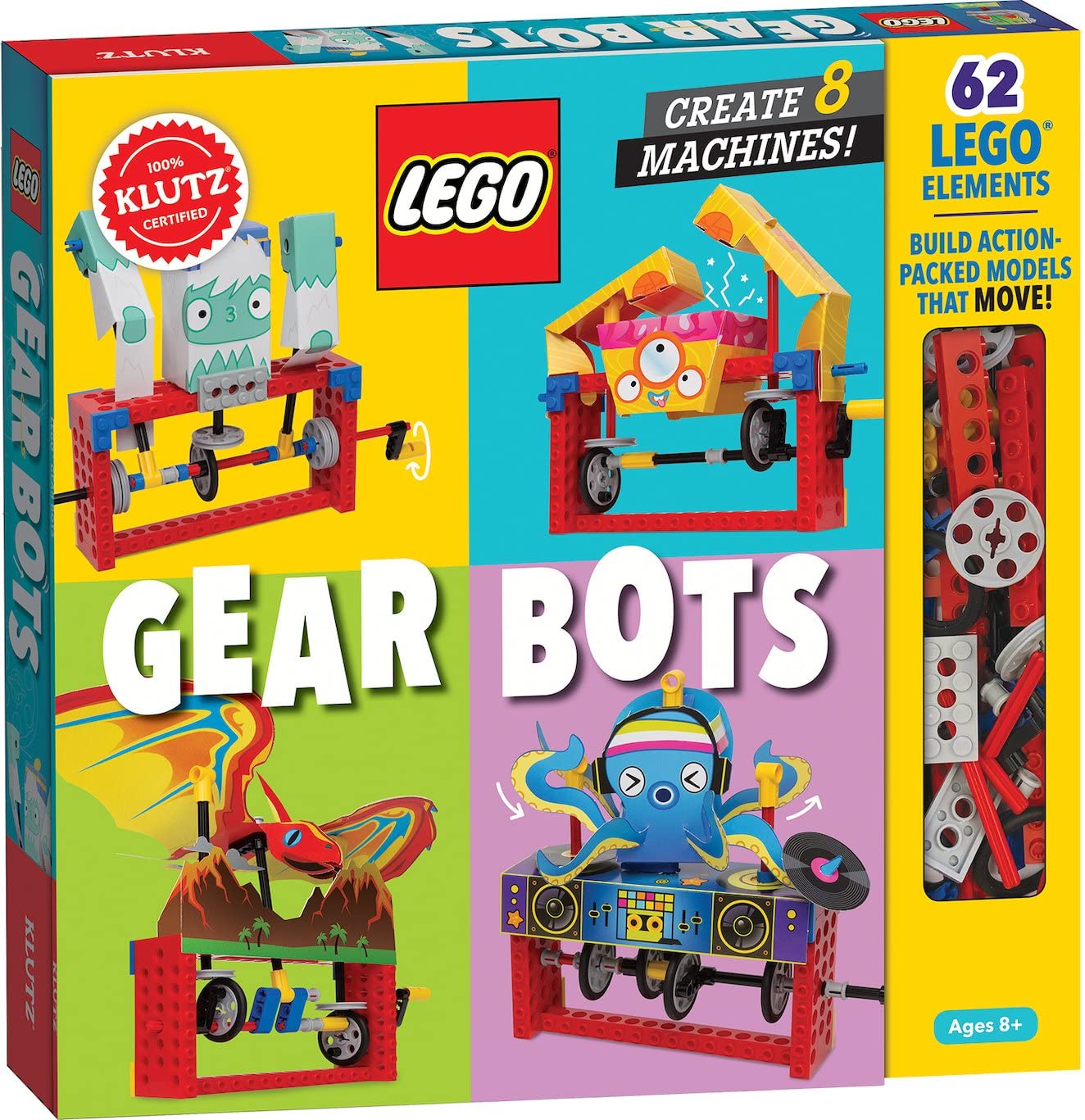
Key Features
- Age Range: 8‑12
- Number of Projects: 8 builds
- Adult Involvement: Parent‑child needed
- Durability: LEGO+paper, fragile
- Price: Mid-Range
The moving paper-LEGO animals are clever, but the models can be delicate—connections may pop apart during motion—and some instruction steps are ambiguous. This kit rewards patient tinkerers who enjoy troubleshooting alongside an adult, not children wanting a durable, ready-to-play robot.
Pros
- Kids create moving paper creatures using LEGO gears that teach cams, cranks, and momentum.
- Finished models are charming, hand-powered bots that make a satisfying project.
Cons
- Instructions have ambiguous steps; imperfect paper cuts may cause gear jams.
Best for LEGO fans who relish rebuilding and parent-child problem-solving, not children seeking a sturdy, independent-play toy.
Best for Jewelry Makers
COO&KOO Charm Bracelet Kit

Key Features
- Age Range: 6‑12
- Adult Involvement: Independent
- Durability: Metal/plastic, fragile
- Price: Mid-Range
The charms look genuinely cute, and the screw-off clasps mean even a 4-year-old can assemble a bracelet with minimal help. The kit is far smaller than online photos suggest — the box fits in a child’s palm, and bracelets may snap after a few wears. This is a dress-up accessory, not a daily-play toy.
Pros
- Charms and finished bracelets look cute, making kids feel like they made real jewelry.
- The unicorn box impresses on first sight and stores the kit afterward.
Cons
- The kit is much smaller than product images suggest, and beads are tiny.
If a unicorn-obsessed child wants a gift that looks magical when opened and you’re fine with occasional, gentle play, this kit delivers that moment.
How to Choose
A 7‑year‑old’s fine‑motor skills and patience vary widely, so the first decision is how much adult involvement the activity requires — and how much you’re willing to give.
Age Range
Official labels like “8+” often overestimate independence for a typical 7‑year‑old, but many kids can still thrive with a bit of help. The gap hides a physical reality: smaller hands may struggle with precise snaps or delicate folding, while a child’s reading level determines whether picture‑based instructions alone are enough.
Match the kit to your child’s frustration tolerance. If they abandon tasks at the first wobble, choose a set with robust pieces and forgiving assembly; if they love puzzles, a challenge just above their current ability can build grit.
Number of Projects
Marketing often inflates project counts by counting minor variations — swapping an LED color isn’t a new experience for a child. For lasting engagement, look for distinct builds that reuse the same components in genuinely different ways, like rebuilding one dinosaur into another or sequencing a marble path through escalating patterns.
A single kit with 3 deep rebuilds frequently outlasts one that advertises 100 similar circuits, simply because each transformation feels like a new toy.
Adult Involvement
Some toys are engineered for solo discovery — pieces snap tightly, instructions are purely visual, and there’s no chemical mess. Others demand a parent’s hands to handle fragile inserts, interpret sparse guides, or manage multi‑day drying times.
Honesty about your own availability matters. A science kit bought for “quiet time” can backfire if it requires constant supervision; conversely, a collaborative build can become a treasured weekend ritual.
Durability
The difference between a toy that lasts three years and one that lasts three weeks often comes down to material choice. Snap‑fit plastic modules hold through hundreds of cycles, while thin metal clasps on charm bracelets can snap after the first wear. Papercraft models, however charming, degrade quickly under repeated folding and rough table bumps.
For gifts that will live in a backpack or travel bag, choose thick cardstock, reinforced plastic, or fabric that can survive being stuffed without tearing.
Battery & Tool Needs
The moment a child opens a box and finds “batteries not included” is a momentum killer. Many mid‑range kits omit AA or AAA cells even though the activity can’t start without them. Worse, some require specialty adhesives or scissors that aren’t standard in a gift‑wrap setup.
Tucking a pack of batteries or a small tool pouch alongside the gift ensures the very first play session doesn’t stall before it begins.
FAQ
Can a 7 year old use Snap Circuits Jr. independently?
Yes, most 7‑year‑olds can follow the picture‑based instructions and snap components without help, though initial sorting of the 30+ parts and battery insertion may need a grown‑up. Once the first project is complete, kids usually build confidence quickly and continue on their own.
Why doesn’t my glow‑in‑the‑dark rock paint glow after charging?
Most kit glow paints require prolonged, intense light exposure — often bright direct sunlight or a strong LED flashlight held close for several minutes — to produce even a faint effect. For a reliable dark‑room glow, a separate blacklight works better than the included paint.
Are National Geographic geodes too hard for a 7 year old to break open?
Yes. The geodes are extremely dense and often need a full‑size hammer swung with adult force; more than 70% of reviewers say children cannot open them alone. Expect to do the breaking yourself, wear safety goggles, and accept that many will shatter into sharp fragments rather than split cleanly.
Is the Crayola Light Up Tracing Pad bright enough for thick paper?
The pad is bright enough for the included thin tracing sheets, but thicker sketch paper or ambient room light can make black outlines difficult to see. Using the supplied paper and drawing in a slightly dimmed room gives the clearest results.
How can I keep Gravity Maze towers from wobbling and popping off?
The towers sit loosely on the grid and can tip if the table is bumped. Placing the game on a firm, level surface and encouraging a gentle touch solves most issues; some users add a thin non‑slip mat underneath for extra stability.