
This post contains affiliate links. We may earn a small commission when you buy through our links — at no extra cost to you.
Shopping for an 18-month-old is a balancing act: you want toys that spark learning and laughter, but many battery-powered options end up in the back of the closet with dead buttons or jammed mechanisms within weeks. The most entertaining toy on the shelf can become the most frustrating when sound modules fail or suction cups won’t stick.
At this age, toddlers are equal parts curious explorers and destructive testers—they’ll mouth, drop, and slam every toy. The real winners are the ones that can withstand those daily rigors while still holding their attention. Among the hundreds of top-rated picks, a surprising number of the most loved toys are simple blocks, stacking cups, and sturdy push-alongs that don’t rely on electronics at all.
That doesn’t mean you have to abandon interactive learning; some electronic books and activity cubes do hold up, especially when you know which features to double-check—like volume control, battery access, and speaker quality. This guide helps you zero in on gifts that keep working, keep them busy, and even travel well, so you can shop with confidence.




Best for Language Development
LeapFrog 100 Words Book
Key Features
- Age & Development: 18+ months, language focus
- Interactivity & Learning: Touch-sensitive pages, 100+ words, bilingual, songs
- Durability: Tear-resistant pages
- Portability: Compact, portable
- Battery Requirements: 2 AA (demo batteries included)
- Price: Mid-Range
The LeapFrog 100 Words Book turns vocabulary into a hands-on activity: touch a page to hear the word in English or Spanish, with a light-up star button for extra interaction. The pages hold up to the grabbing and bending typical of 18-month-olds — no torn flaps or loose parts to worry about. Batteries may arrive depleted from demo use, so keeping a spare set of AA’s on hand is wise.
This is a solid pick for parents who want a travel-friendly electronic book that encourages language development without a screen. The speaker can become muffled over time in households where the book gets heavy daily use — something to watch for rather than a dealbreaker for most.
Pros
- Touch-and-hear pages make word learning active and engaging for toddlers
- Bilingual English/Spanish mode exposes toddlers to a second language naturally
- Durable pages resist tearing from rough handling by 18-month-olds
Cons
- Batteries included may be depleted upon arrival, so fresh AA’s are recommended from the start
- Speaker can become muffled or stop working after extended use — more noticeable with frequent daily play
For families prioritizing early language development in a portable, screen-free format, this is a well-considered investment — just keep spare batteries and monitor the speaker.
Best for Creative Building
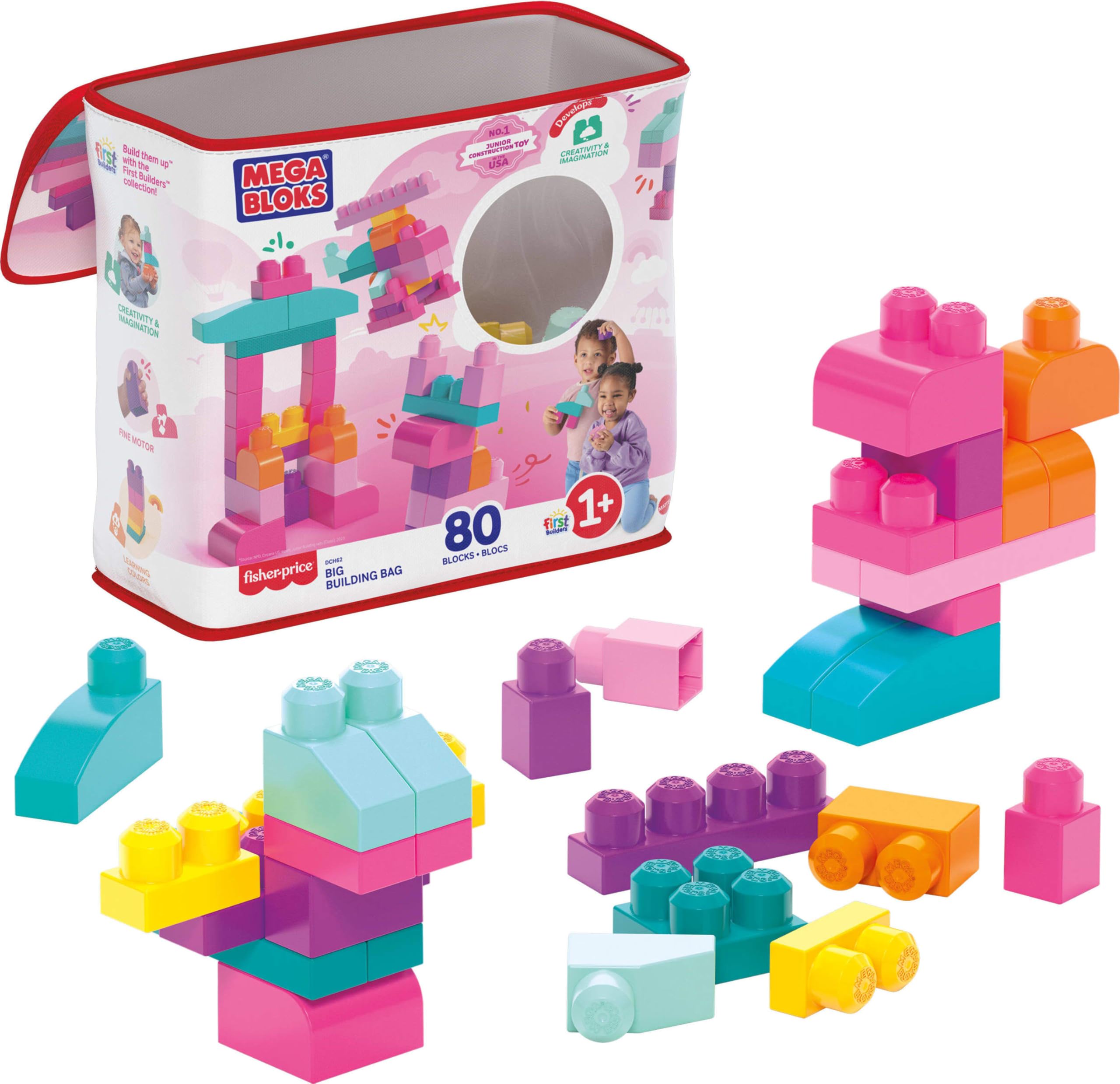
Mega Bloks 80-Piece Bag
Key Features
- Age & Development: 1+ years, fine motor skills
- Interactivity & Learning: No electronics, open-ended building
- Durability: Oversized plastic blocks
- Portability: Storage bag included
- Price: Budget
The Mega Bloks 80-Piece Bag delivers exactly what a first building set should: chunky blocks that are easy for little hands to grab, stack, and unstack. Colors are bright and shapes varied, which naturally encourages color recognition and imaginative arrangements without any screens or sound effects. While the electronic top pick in this guide focuses on words and lights, this set keeps toddlers engaged through the physical challenge of balancing and arranging, fostering fine motor skills and creativity for hours.
This bag is a budget-friendly gift for toddlers who are learning to manipulate objects and don’t need batteries to hold their attention. The connection between blocks can feel intentionally loose, so towers may topple with minimal nudging—a design quirk that suits children who enjoy the process of stacking and knocking down more than building tall, permanent structures. It’s less ideal for toddlers who get upset when things fall apart unexpectedly.
Pros
- Chunky blocks are sized for small hands to grasp, stack, and unstack easily, building fine motor skills.
- Keeps toddlers engaged for long stretches, sparking open-ended creative play.
- Generous 80-piece count and included storage bag make this a strong value for the price.
Cons
- Towers can topple easily when stacked beyond a few blocks high, as some pieces fit loosely—a frustration for toddlers expecting sturdy structures.
If your toddler finds delight in stacking and gleefully knocking blocks down rather than trying to keep them upright, this budget set delivers hours of hands-on creative play with no electronics needed.
Best for Pretend Play
LeapFrog Picnic Basket
Key Features
- Age & Development: 6-48 months, shapes & sharing
- Interactivity & Learning: 3 play modes, shape-sorting, songs
- Durability: Plastic food pieces, sturdy basket
- Portability: Compact basket with handle
- Battery Requirements: 3 AA (demo included)
- Price: Mid-Range
The picnic basket uses a 15-piece tea-party setup to teach shapes, colors, and sharing, setting it apart from word-focused toys. Each plastic food piece lights up and plays polite songs about manners when fitted into the correct spot, and the basket toggles between music, shape, and picnic play modes to keep the interaction varied.
For an 18-month-old who loves serving pretend treats, the social role-play hook holds attention long after a flashcard would be tossed aside. The basket’s short handle makes independent carrying awkward, so it works best on a table or lap — not toted room to room. The 15-piece set needs a dedicated shelf to stay tidy, but the woven basket itself contains the clutter nicely for families who can stash it away.
Pros
- Shape-sorting food pieces turn color and matching lessons into hands-on pretend play.
- Multiple modes — music, shapes, and picnic time — keep the experience fresh across many play sessions.
- The charming picnic design makes it a standout first-birthday gift, consistently praised by gift-givers.
Cons
For a toddler who gravitates toward tea parties and social play, this basket turns shape learning into a shared activity that feels more like a treat than a lesson. The full set’s mid-range price is justified by its ability to make sharing practice feel special.
Best for Early Balance
SEREED 4-Wheel Balance Bike
Key Features
- Age & Development: 12-24 months, balance
- Interactivity & Learning: No electronics, ride-on
- Durability: Aluminum frame, light
- Portability: Indoor use, lightweight
- Price: Mid-Range
The SEREED Baby Balance Bike prioritizes stability over long-term growth. Its four-wheel design and 135° steering limiter prevent the tip-overs that spook new walkers, while the tool-free assembly gets it out of the box and onto the floor in minutes. At 3.6 pounds, toddlers can maneuver it indoors without scuffing floors.
The trade-off is a seat height that suits small to average-size 12-18-month-olds. Taller 18-month-olds may find their knees bumping the handlebars, and the frame won’t accommodate most children beyond age two. This is a first introduction to balance, not a bike that grows with the child.
Pros
- Tool-free assembly takes minutes — no hunting for a screwdriver.
- Four-wheel stance and limited steering arc reduce tip-overs, giving wobbly walkers the confidence to push and coast.
- Lightweight aluminum frame lets toddlers lift and redirect the bike on their own, building early coordination.
Cons
- The low seat height may limit use beyond 18 months for taller toddlers, shortening the bike’s useful window.
At 18 months, height, not age, determines fit. The SEREED works well for smaller toddlers still wobbly on their feet, but taller kids may outgrow it within a few months.
Best for Multi-Sensory Play
VTech Activity Cube
Key Features
- Age & Development: 6-36 months, sensorimotor
- Interactivity & Learning: 14 features, lights, sounds, animals
- Durability: Sturdy cube, drop-resistant
- Battery Requirements: 2 AAA (included)
- Price: Mid-Range
Unlike portable electronic toys that follow a child around, this 5-sided cube creates a stable base for early sitters to pull up on, tap, slide, and spin. It suits parents of 6- to 18-month-olds who want a single toy that encourages independent sitting while building fine motor skills and introducing animal names, shapes, and colors. The electronic songs and sound effects are enthusiastic — volume control offers only partial relief, so it’s best placed in a playroom rather than a quiet living space.
Pros
- Multiple activities keep babies engaged and encourage sustained sitting.
- Develops fine motor skills and early vocabulary through fingertip discovery.
- Sturdy construction withstands drops and rough play.
Cons
- Songs and sounds can be loud; volume control offers limited relief.
A durable sit-down activity center for infants mastering balance, especially when portability isn’t a priority.
Best for On-The-Go Play
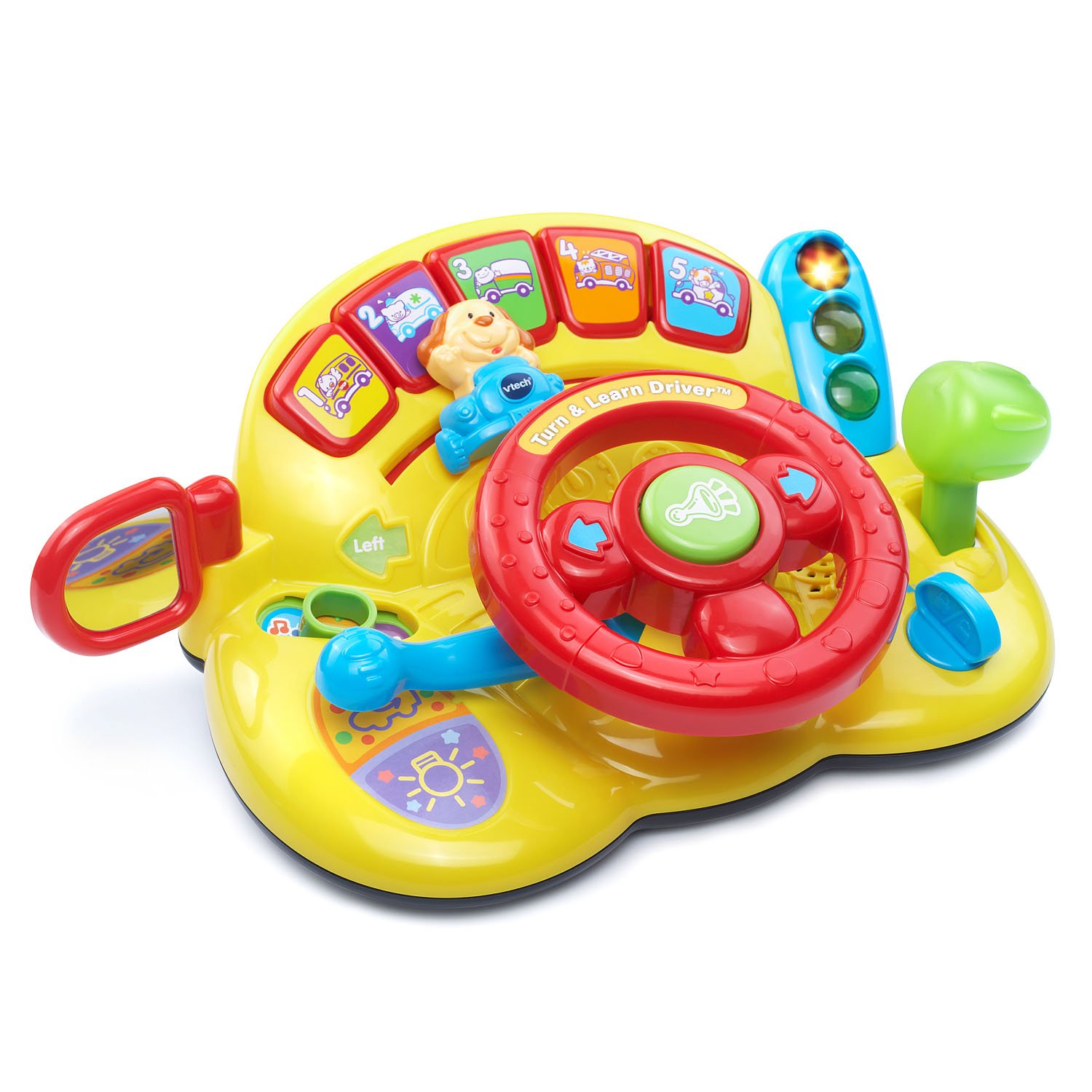
VTech Turn and Learn Driver
Key Features
- Age & Development: 6-36 months, role-play
- Interactivity & Learning: Steering wheel, 60+ sounds, lights
- Durability: Durable plastic, drop-resistant
- Portability: Compact, travel-friendly
- Battery Requirements: 2 AA (included)
- Price: Mid-Range
Unlike stationary activity cubes that encourage sitting and exploring, this steering wheel puts pretend driving in a toddler’s hands — with a horn, blinkers, gear shift, and 60+ sounds that reward every twist. The compact design slips easily into a diaper bag and keeps a car-obsessed 18-month-old engaged during car rides and flights. The low volume setting tames the audio somewhat, but the sounds can still feel loud in a confined space; this works best for families who can tolerate cheerful noise in exchange for focused independent play.
Pros
- Realistic buttons, horn, and gear shift spark imaginative driving that holds an 18-month-old’s attention.
- Compact enough to stash in a diaper bag, providing a familiar play ritual during car trips and flights.
- Tough build withstands being dropped or knocked around by enthusiastic toddlers.
Cons
- Low volume setting still produces energetic sounds that can feel intrusive in a quiet car or small room.
For a vehicle-fascinated 18-month-old who travels often, the VTech Driver channels that fixation into focused pretend play. Skip it only if you need a quieter toy for shared spaces.
Best for Dexterity Building
Fisher-Price Piggy Bank
Key Features
- Age & Development: 6-36 months, fine motor
- Interactivity & Learning: 40+ songs, counting, Spanish
- Durability: Plastic coins, durable body
- Portability: Compact piggy bank
- Battery Requirements: 2 AA (included)
- Price: Mid-Range
10 chunky coins and 40+ songs reward the pincer grasp, making this a fine motor workout with counting and Spanish exposure. Two Smart Stages levels adjust difficulty, and the cute design keeps toddlers engaged. For 18-month-olds building dexterity, this is a solid pick—though the coin sensor may miss some drops, and the fixed volume can be low in louder playrooms.
Pros
- Builds fine motor precision and hand-eye coordination through coin insertion play
- Entertaining put-and-take action that toddlers enjoy independently
- Cute, engaging design that encourages repeated play
Cons
- Coins may not trigger songs if not inserted straight into the slot
- Speaker volume is fixed and may be too low for active or noisy environments
A focused fine motor toy that delivers on skill-building—best for quieter play sessions where the coin sensor’s occasional miss won’t frustrate.
Best for Bath Play
First Years Stacking Cups

Key Features
- Age & Development: 9 months+, stacking & counting
- Interactivity & Learning: No electronics, color/number recognition
- Durability: BPA-free plastic, chewable
- Portability: Compact, lightweight, bath & travel
- Price: Budget
The eight cups nest and stack easily, with numbered bottoms for early counting. They offer good durability and strong value for bath or floor play. They are lightweight and pack small for travel. However, the design is extremely basic compared to electronic learning toys that add sounds and lights.
Pros
- Multi-purpose for stacking, nesting, water play, and counting.
- Withstands chewing and rough toddler play.
Cons
- Cups are smaller than expected – better suited for indoor sensory play than beach or large water tables.
A smart budget buy for bath and floor play.
Best for Early Sorting
Fisher-Price Shape Sorter

Key Features
- Age & Development: 6+ months, shapes/colors
- Interactivity & Learning: Shape-sorter, no electronics
- Durability: Plastic blocks and bucket
- Portability: Bucket with handle
- Price: Budget
The shape sorter does exactly what you’d expect — 10 chunky blocks teach shapes and colors, the bucket has a carrying handle, and it’s budget-friendly. The lid, however, can detach during play, which may frustrate an 18-month-old who can’t snap it back on themselves. This is a supervised-play toy, not an independent exploration piece.
Pros
- Teaches shapes, colors, and early problem-solving through hands-on sorting.
- Holds an 18-month-old’s attention with stacking and dumping action.
Cons
- The lid can detach with little effort, potentially interrupting a toddler’s independent play.
For supervised play sessions where an adult can snap the lid back on, this budget-friendly sorter does the shape-matching job well.
Best for Ms. Rachel Fans
Ms. Rachel Singing Doll

Key Features
- Age & Development: 6 months-3+, speech imitation
- Interactivity & Learning: 4 songs, 16+ phrases, soft plush
- Durability: Soft plush, clear soundbox
- Portability: Portable soft doll
- Battery Requirements: 2 AAA (included)
- Price: Budget
The soft plush and Ms. Rachel’s recognizable voice create an instant comfort object for little fans, and the spoken phrases encourage language imitation. But with only four songs and buttons that can be tough for 18-month-old fingers to press alone, this is a cuddle-time companion, not a self-directed plaything. It shines for toddlers already attached to the show.
Pros
- Soft and cuddly design makes it easy for toddlers to carry and sleep with.
- Familiar voice and songs delight Ms. Rachel fans and prompt language imitation.
Cons
- Buttons may be too stiff for the youngest toddlers to press independently, requiring adult help.
A comforting plush for toddlers who already love Ms. Rachel and will enjoy hearing her voice while being held — less suited for kids who want a toy they can activate on their own.
Best for Gentle Bouncing
iLearn Bouncy Unicorn

Key Features
- Age & Development: 18 months+, gross motor
- Interactivity & Learning: No electronics, inflatable hopper
- Durability: Plush inflatable, soft
- Portability: Lightweight, indoor/outdoor
- Price: Mid-Range
The plush unicorn design delights toddlers and inflates in under 30 seconds. Gentle bouncing helps with balance, but the air bladder may slowly deflate and some taller 18-month-olds may find the seat low, limiting its appeal for older or more active bouncers.
Pros
- Adorable unicorn design with soft plush cover that toddlers love
- Easy to inflate in under 30 seconds
Cons
- Air may slowly escape over time, requiring re-inflation to maintain bounce height
This hopper works well for young toddlers under 2 who enjoy gentle bouncing on a soft plush ride, especially if re-inflating a few times isn’t a dealbreaker.
Best for Travel Distraction
ALASOU Suction Spinners 3-Pack

Key Features
- Age & Development: 12+ months, sensory spinning
- Interactivity & Learning: No electronics, spinning tops
- Durability: Plastic spinners, suction cups
- Portability: Compact, suction to surfaces
- Price: Budget
These little spinners spin fast on glossy highchair trays, airplane windows, or bathroom tiles, keeping an 18-month-old absorbed. The base can detach from the spinner body after hard drops, so they suit gentle hands best. For short outings and supervised play, they deliver a lot of spin-time fun for the price.
Pros
- Keeps toddlers occupied for long stretches, especially during meals or travel.
- Cheerful insect designs—butterfly, bee, ladybug—grab attention instantly.
Cons
- Suction cups won’t hold on textured, dusty, or matte surfaces—only glossy, spotless planes work.
Use these when you need a few minutes of quiet at a restaurant with a clean table; skip them if you want suction that works on every surface or if your toddler throws toys.
How to Choose
The best gift for an 18-month-old isn’t the one with the most buttons, but the one that matches your child’s current motor skills and lasts more than a month.
Age-Appropriate Challenge
Many toys labeled for 6+ months entertain a newborn but bore a mobile toddler who craves cause-and-effect action. Look for features that offer two or more ‘stages’—like progressive counting levels or shape-matching modes—so the toy adapts as your child’s understanding deepens.
A toy that is too simple ends up ignored, while one that’s slightly beyond their grasp can spark longer engagement if it rewards repeated attempts rather than punishing failure.
Interactive Sound & Light
Interactive toys with songs, lights, and phrases captivate toddlers, but many lack sufficient volume control or a mute option. The hidden trade-off: motors and speakers that run constantly not only drain batteries rapidly but also can overwhelm a sensitive child or a quiet household.
Prioritize toys with at least a high/low switch or the ability to turn off sounds entirely. Some electronic books and cubes offer a silent mode while retaining touch-based feedback, preserving the learning without the noise fatigue.
Durability That Survives Toddlers
An 18-month-old will mouth, drop, and throw toys from high chair height. Plastic pieces that look sturdy often have weak joints—like suction cup bases that snap off or pop-up mechanisms that seize after a few jams. Blocks that don’t interlock firmly can frustrate a builder who sees towers collapse with a nudge.
Check reviews for common breakage points: speaker grilles, spinning gears, and handle connections. Open-ended toys without moving parts (like stacking cups or large blocks) typically outlast those with springs or sensors.
Portability & Travel-Friendliness
A toy that flies off your car seat tray or scatters 20 pieces on an airplane floor creates more stress than delight. Seek compact designs with a small number of attached or contained parts—a book with built-in pages, a steering wheel that sits in the lap, or a bag with zippered storage.
Suction-based toys can work on glossy highchair trays but rarely hold on textured tray tables. For flights, prioritize toys that operate quietly without battery-dependent features that may be confiscated or run out mid-trip.
Battery Strategy
Demo batteries included in packaging are often depleted by the time you unbox the gift. Always have a fresh set of the required type on hand, and look for battery compartments that open with a simple screwdriver—you’ll need to swap them frequently.
Some motion-activated toys drain power even when sitting idle. Consider rechargeable batteries for high-draw items, or opt for toys with an off-switch that fully kills the circuit rather than a dim standby mode.
FAQ
Why does my toddler’s VTech activity cube drain batteries so quickly?
The cube’s motion sensor and light-up features stay active during play, and its speaker draws constant power. Use the auto-shutoff function and remove batteries when the toy sits unused for days. If drain is still rapid, switch to lithium batteries; they handle the steady draw better than standard alkaline cells.
Do suction cup spinner toys stay on airplane tray tables?
Suction cups need a perfectly smooth, non-porous surface to grip. Most airplane tray tables have a slight texture that weakens the seal, causing spinners to pop off. They stick better to glossy highchair trays, bathroom mirrors, or windows. For air travel, bring a damp wipe to clean the surface and re-moisten the cup for a temporary hold.
Are Mega Bloks too big to pack for travel?
The full 80-piece bag is bulky, but you can easily pack a smaller selection in the included bag or a zippered pouch. The blocks are lightweight and easy to clean, so bringing 20–30 pieces gives plenty of building variety without consuming carry-on space. Many parents keep a dedicated travel pouch ready.
Can an 18-month-old actually balance on a 4-wheel bike?
It’s not balancing in the cycling sense; the four wheels keep the bike upright while the toddler straddles and pushes with their feet. This builds leg strength and steering coordination without the tipping risk of a two-wheeler. Most 18-month-olds can walk themselves along while seated, and the 135° turn limit prevents sharp tipping.